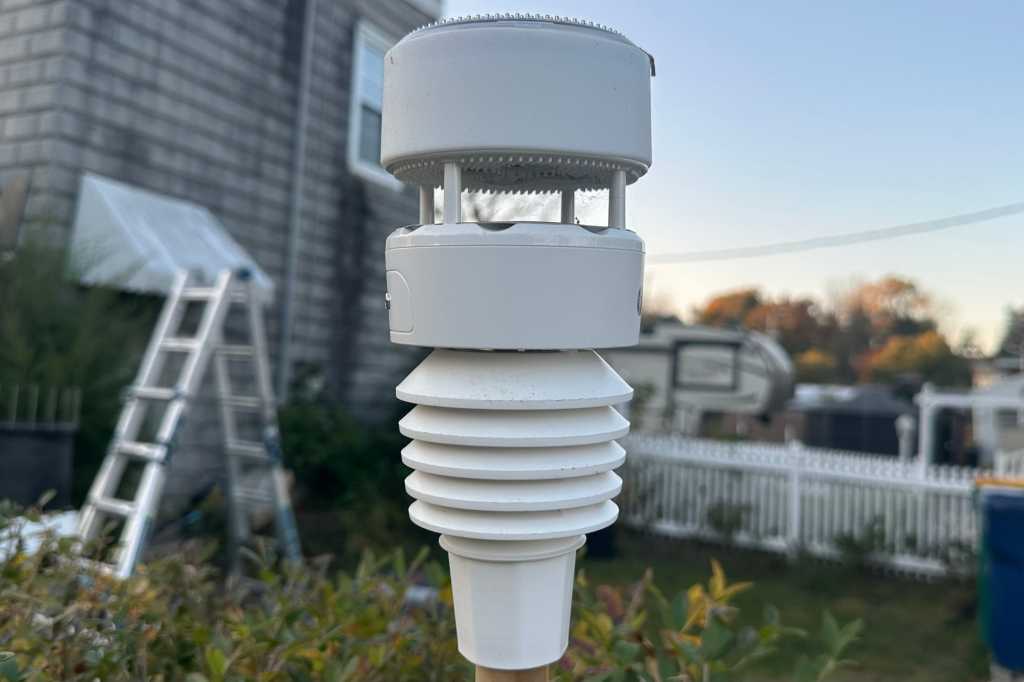

At a glance
Expert’s Rating
Pros
– Accurate temperature, humidity, and wind readings
– Extremely compact design
– Includes a discrete thermometer–barometer–hygrometer for indoor monitoring
Cons
– Uses a non-standard mast size (1.0-inch vs. typical 1.25-inch)
– Haptic rain gauge is no more accurate than WeatherFlow Tempest’s
– Not much better overall than the less-expensive Ecowitt Wittboy Pro
Our verdict
This is a great home weather station, and Ambient Weather’s software and weather network are hard to beat, but the Ambient Weather WS-4000 is otherwise identical to the less expensive Ecowitt Wittboy Pro. And both products have problematic haptic rain sensors.
Price when reviewed: $374.99 (best pricing at Amazon)
Summary
The haptic rain sensor first popularized by the WeatherFlow Tempest has been copied widely. The WS-4000’s design comes from Fine Offset Electronics and mirrors the Ecowitt Wittboy series; Ambient Weather’s parent company licensed Fine Offset designs for several Ambient models. The WS-4000 is essentially the Ecowitt Wittboy Pro with Ambient Weather branding and a bundled indoor sensor and console.
Design and specifications
The WS-4000 is an all-in-one, no-moving-parts sensor suite. It follows the Tempest-style layout: temperature and humidity sensors on the bottom, a sonic anemometer on top, and haptic rain, UV, and light sensors in the upper body. Ambient Weather bundles a WH32B indoor thermometer–barometer–hygrometer with the WS-4000; the WeatherFlow Tempest lacks such an included indoor sensor but adds a lightning sensor on its system. The Wittboy integrates indoor readings into its console but also lacks a lightning sensor.
Ambient Weather uses its Ambient Weather Network (AWN) for connectivity. AWN is free; a $50/year subscription adds up to three years of historical data and extra map layers.
Installation and setup
The WS-4000 is straightforward to set up, but it ships with only a quick-start guide rather than a full manual. A notable gotcha: it requires a 1.0-inch mast rather than the more common 1.25-inch mast. That’s inconvenient if you’re replacing an existing station; I used a 1-inch wooden dowel. The station includes a solar panel and two AA batteries for backup in the sensor suite; the console and indoor sensor require their own power.
The Ambient Weather Network app is great
Where Ambient Weather stations shine is software and smart-home integration. The AWN app has a clean interface and supports IFTTT and Amazon Alexa. Google Home is no longer supported due to API changes, and Ambient Weather does not plan to restore compatibility. The AWN app and integrations make Ambient Weather stations an excellent choice for a connected home.
Sensor performance
Temperature, humidity, and the sonic anemometer performed very well. Sonic anemometers offer superior sensitivity and often better accuracy than cup-and-vane sensors, and they handle high winds (the type of extremes most users will never see) better than alternatives. The WS-4000’s compact footprint is unobtrusive and blends into a yard more successfully than bulkier units.
The WS-4000’s console is bright and readable from a distance and supports adding extra sensors. The console generally auto-detects added sensors and displays their data, though users have reported mixed experiences across Ambient Weather products.
The rain issue: haptic sensor shortcomings
The WS-4000 uses a haptic (vibration-based) rain sensor similar to the Tempest and Fine Offset designs. In practice, haptic rain gauges have proven less accurate than conventional tipping-bucket or weighing gauges. The WS-4000’s rain readings were unreliable unless the top of the sensor was perfectly level, and performance in light rain and drizzle was poor. WeatherFlow has improved Tempest accuracy over time but heavy-rain performance remains imperfect. Ecowitt even recommends its WH40 tipping rain gauge if you need precise rainfall data—an accessory that adds about $50.
Should you buy the WS-4000?
If you already use Ambient Weather and want to upgrade without leaving the platform, the WS-4000 is an excellent and compact option, especially for accurate temperature, humidity, and wind readings plus a readable console and included indoor sensor. However, if rainfall accuracy is critical, plan to add a dedicated tipping or weighing rain gauge. Also consider the Ecowitt Wittboy Pro, which is based on the same Fine Offset design and costs roughly $70 less; it also comes with a console. I haven’t personally tested the Wittboy Pro, but its shared design and lower price make it worth evaluating alongside the WS-4000.
Long-term testing is planned to assess the haptic rain sensor through wetter seasons. For buyers seeking a first weather station, consider the trade-offs: excellent overall sensing and software versus documented rain-measurement limitations.
Author: Ed Oswald, Contributor
Ed is a science and technology journalist from Reading, Pennsylvania, covering emerging technologies for more than 20 years. His work has appeared in TechHive, PCWorld, Digital Trends, Popular Mechanics, and more. Ed holds a BA in Journalism from Temple University and studied meteorology at Millersville University. He runs the weather gadget reviews site The Weather Station Experts.